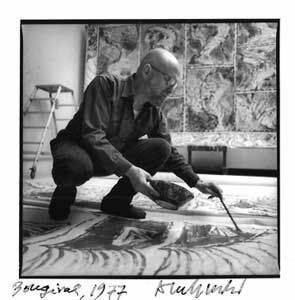
Pierre Alechinsky
P.A as he liked to be known, was born on October 19th 1927 in Saint-Gilles, in Brussels. His father was a naturalised Belgian and his mother was from Wallonne, in Belgium. They were both doctors.
1944 He attended the School of Architecture and Decorative Art la Cambre, in Brussels (which had been founded by Henry van de Velde in 1928.) He studied illustration, and printing techniques. Among other things he worked on illustrations for an extract from Kodak by Blaise Cendrars. By a strange turn of events, fifty years later Cendrar's daugther, Miriam, asked him to illustrate some previously unpublished work by her father!
1946 He began to paint, and belonged to a group called " la jeune peinture belge " ( young Belgian painting ) where he met Paul Bury, and became friends with Christian Dotremont. He joined the COBRA movement and worked on the Cobra Journal and exhibitions with Dotremont.
1951 After the movement disbanded, he went to Paris where he had obtained a grant to study engraving at "l'atelier 17", with Stanley William Hayter. He moved to rue de Messin and spent his time with surrealists whose automatic writing fascinated him.
1954 His first exhibition in Paris, at the Nina Dausset gallery, Christian Dotremont wrote the preface. It was here that he met Walasse Ting who taught him calligraphy, and inspired him to travel to the far East.
1957 He went to Japan, accompanied by his wife Micky (Michèle Dendal) where he was able to work on calligraphy with Shiryu Moriya, with whom he had been corresponding for a number of years.While he was in Kyoto he made a documentary film called Japanese calligraphy, for which Dotremont did the commentary. He did his first large works in ink on woven paper.
1962 He made frequent trips to the U.S.A. and his work appeared regularly at the Lefebre gallery in New york and the galerie de France in Paris .
1963 He left the Belleville quarter of Paris and moved to Bougival, rue Henri- Barbusse.
1965 He took part in an international exhibition on Surrealism "l'écart absolu" with Central Park, his first acrylic painted in New york; there were little drawings in indian ink, all around the main image which he called remarques marginales (marks in the margins). This was a new form of typology which he still uses today.
1966 P.A. published Idéotraces ( Denoël printers ), a series of texts about painting, which he had written in 1953. A number of other books followed, about poetry and his own work. He painted on different media, such as on stock market bonds (1973), on old manuscripts from Michel Butor "tapuscrits" (tapuscripts), on old documents from "la Maison d'Aremberg" (1977), on old legal documents (1979), on geographical maps (1980) and pages from atlas (1984). He also illustrared works with etchings or "aquatintes" by poets and writers, including :
Yves Bonnefoy 1923 -
L'Excédante F.B. 1982 8 p.
etchings and lithographs by Pierre Alechinsky
Quatre pas dans l'intraduisible
F.B.1991 12 p
Four steps into the untranslatable
engravings by Pierre Alechinsky
L'été de nuit De nachtzomer Ergo Pers, Ghent, 2002
Summer of night
3 etchings by Pierre Alechinsky
64 copies on Hahnemühle numbered with a group of 3 etchings
Par expérience F.B. 1976 8 p
Through experience
illustrations by Pierre Alechinsky
Michel Butor 1926
Hoirie -Voierie edition Giorgio Soavi pour Olivetti,Turin 1970
poems by M. Butor
12 copies of drawings known as "revivals"
1000 copies H.C. including 100 with 1 etching + 20 E.A.
Le rêve de l'amonite editions Fata Morgana, Montpellier 1975
Amonite dream
Text by M. Butor
5 etchings and lithographic remarks, boxed set
Matériel pour un Dom Juan
Material for a Don Juan
Text by M. Butor, J.Y Bosseur and Pierre Alechinsky 1977
Tourmente editions Fata Morgana, Montpellier 1968
Torment
11 poems by M. Butor
4 drawings by Alechinsky, Bernard Dufour and Jacques Hérold, presented like architect's drawings
130 copies
Charles-Albert Cingria 1883 - 1954
Le carnet du chat sauvage ed Fata Morgana 2000
The wild cat note-book
inks and prints by Pierre Alechinsky
6 plates
500 copies including 485 on ivory laid paper
Emile Cioran Emile Michel Cioran Rasinari 1911 - 1954
Vacillations editions Fata Morgana Montpallier 1979
32 lithographs in colour including those on the cover
25 copies on vellum, signed
+ a collection of 32 embossed watercolour lithographs, also signed
Schismes Editions Maeght 1978
4 lithographs in colour, signed
150 copies,numbered and signed + 20 EA + 10 HC
Christian Dotremont 1922 - 1979
La reine des murs galerie de France edition Paris 1960
Queen of the walls
Text by C.Dotremont
1 collection of 7 lithographs
65 copies + 10 copies with 1 suite of drawings
Moi qui j'avais edition aux dépens d'un ami printing funded by a friend Paris 1961
Text by C. Dotremont
1lithographed label on the cover
300 copies
André Frénaud 1907 - 1993
La Vie Comme
Elle Tourne and par Exemple Paris Maeght
1979
Life as it goes and for Example
90 copies numbered and signed by Alechinsky and André Frenaud
with 3 etchings signed by Alechinsky on legal documents
510 copies, embossed cover + 20 E.A .+ 10 H.C.
Jean Tardieu 1903 - 1995
Le jardin fragile coll Albums Beaux livres, Gallimard
23 illustrations + cover illustrated by Alechinsky
André Verdet 1913 - 2004
Les exercices du regard edition Galilée Paris 1991
poems by André Verdet
1600 copies
+ 115 copies on paper untrimmed with 1 etching by Pierre Alechinsky
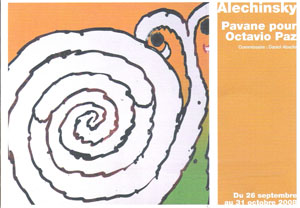
His fame was confirmed when he was awarded the Andrew Mellon in 1976 for his work; he joined the Ecole supérieure des Beaux-Arts de Paris in 1983 where he spent four years teaching painting, he was awarded honours in Belgium where he was made Chevalier de l'ordre de la couronne belge - Knight of the Belgian crown in 1985. He received commissions for work such as the decor for the Ministry of Culture (1985), a gigantic painting for the Ministry of Finance in 1989, for the entrance to the Theatre de Belgique in Brussels in 1998 ) and finally the exhibition organised by the Solomon Guggenheim Museum in New York (1987) as well as retrospectives of his work, held in Paris, at the Jeu de Paume gallery (1988), at Beaubourg (2004) and at the Royal Museums in Belgium (2007-2008) not forgetting the exhibition held by the Mexican Institute in Paris ( 26.09 31.10 2008 ) which according to Daniel Abadie showed everything that was held in common by Alechinsky and the poet Octavio Paz.
|
Danièle Sicard |
|
|
multiple sources All rights reserved |
|
|
|
|